
Introduction
Welcome to Part 5 of my blog series, “How To Break Into DFIR.” In this final installment, we’ll explore the various specializations that DFIR practitioners often pursue after gaining a few years of experience. At this stage, you should already be comfortable with core disciplines such as Windows Forensics, Windows Memory Forensics, and Threat Hunting. These foundational skills give you the launchpad to explore advanced focus areas.
In DFIR, specialists are often referred to as subject matter experts (SMEs). SMEs are critical to investigations, stepping in when cases require deep expertise. For example, an engagement might involve a cloud compromise, or it may focus entirely on Linux systems—situations where specialized knowledge becomes indispensable. This is why the most successful analysts don’t stop at mastering the basics; they continually expand their expertise to become well-rounded practitioners, eventually developing into SMEs themselves.
In this post, we’ll highlight key DFIR specializations and the resources that can help you explore them. Unlike earlier parts of the series, the order of specializations here doesn’t matter—my goal is to outline the paths available and point you toward practical resources, including hands-on labs from CyberDefenders and structured training from SANS. While this isn’t an exhaustive list, it’s a curated selection of the most helpful and widely adopted resources for developing deeper expertise.
Linux Forensics
Linux forensics focuses on investigating and analyzing Linux-based systems. A practical starting point is hands-on labs via CyberDefenders, which simulate real-world scenarios. From there, you can progress into structured formal training, such as SANS.
Step 1 – CyberDefenders Labs
Log into your CyberDefenders account and navigate to Practice > Labs then filter for Community (Content) and then filter further for Linux (Operating System) and Endpoint Forensics (Category).
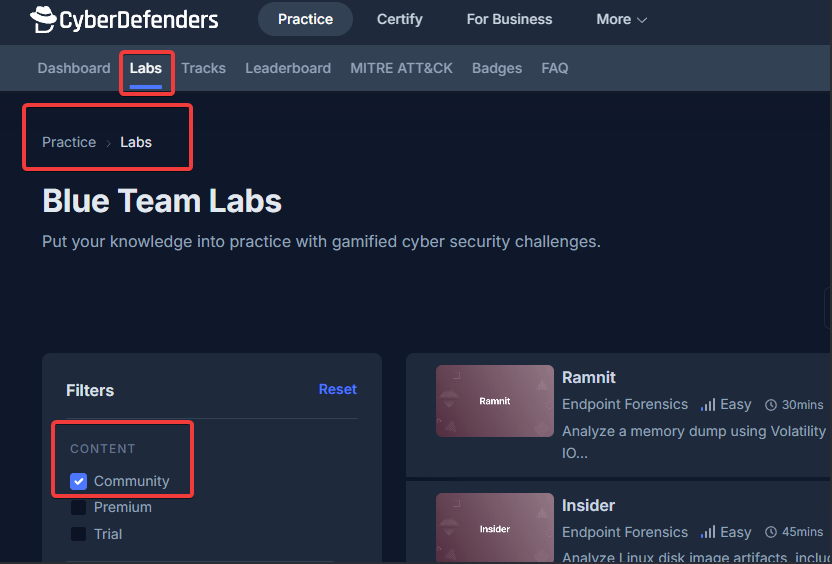
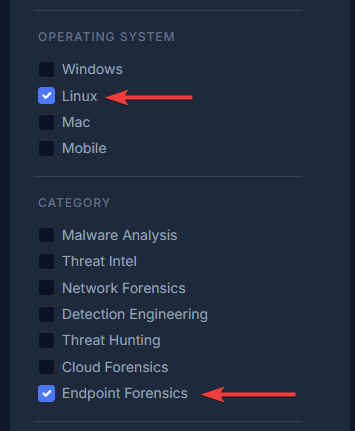
At the time of this writing, eight free Linux labs are available. Premium labs require a subscription ($20/month or $16.67/month annually) and include 10 Linux-focused labs.
Step 2 – 13Cubed: Investigating Linux Devices
Investigating Linux Devices by 13Cubed includes 50 lessons with 365-day access, culminating in a knowledge assessment and certification opportunity. The price is $895 USD. It’s a strong foundation for advancing Linux forensic expertise.
Step 3 – SANS FOR577: LINUX Incident Response and Threat Hunting
FOR577: LINUX Incident Response and Threat Hunting from SANS provides deep coverage of Linux incident response, disk analysis, log analysis, live response, and advanced techniques, concluding with the Day 6 APT Incident Response Challenge. Students may pursue the GIAC Linux Incident Responder (GLIR) certification. The course costs ~$8,780 USD, with an additional $999 for certification. Employer sponsorship is recommended; completing the 13Cubed course beforehand is a good prerequisite.
macOS Forensics
Once comfortable with Linux forensics, you can apply similar techniques to macOS systems, which present their own unique challenges. Hands-on practice with CyberDefenders labs provides practical exposure, and formalized SANS training builds structured expertise.
Step 1 – CyberDefenders Labs
Filter for Community content, then select Mac (Operating System) and Endpoint Forensics (Category).
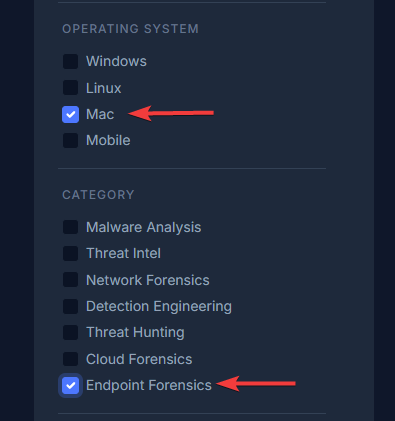
At the time of writing, one free and one premium macOS lab are available. Premium labs require a subscription ($20/month or $16.67/month annually).
Step 2 – 13Cubed: Investigating macOS Endpoints
13Cubed’s Investigating macOS Endpoints course contains 49 lessons with 365-day access and a certification opportunity. Price: $895 USD.
Step 3 – SANS FOR518: Mac and iOS Forensic Analysis and Incident Response
FOR518: Mac and iOS Forensic Analysis and Incident Response from SANS covers macOS/iOS essentials, file systems, logs, user and application data analysis, and concludes with a capstone challenge. Students may pursue the GIAC iOS and macOS Examiner (GIME) certification. The course costs ~$8,780 USD, with $999 for certification. Employer sponsorship is recommended; the 13Cubed course is a solid prerequisite.
Mobile Forensics
Mobile forensics focuses on smartphones and tablets. Hands-on labs provide exposure to the unique challenges of mobile investigations, while SANS provides structured training.
Step 1 – CyberDefenders Labs
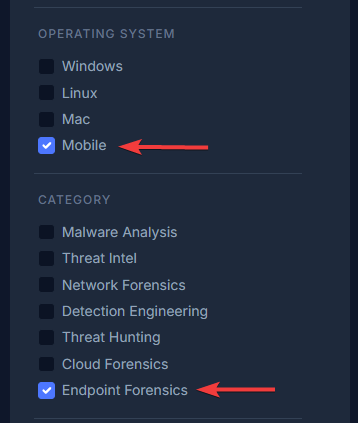
Filter for Community, then Mobile (Operating System) and Endpoint Forensics (Category). Five free labs are available, with three premium labs requiring a subscription ($20/month or $16.67/month annually).
Step 2 – SANS FOR585: Smartphone Forensic Analysis In-Depth
FOR585: Smartphone Forensic Analysis In-Depth from SANS covers smartphone fundamentals, Android/iOS forensics, SQLite, backups, malware, and capstone exercises. Students may pursue the GIAC Advanced Smartphone Forensics (GASF) certification. Course cost: ~$8,780 USD, with $999 for certification. Employer sponsorship is recommended.
Network Forensics
Network forensics involve analyzing traffic, logs, and communications to detect incidents. Hands-on CyberDefenders labs provide practical experience, while SANS training develops advanced skills.
Step 1 – CyberDefenders Labs
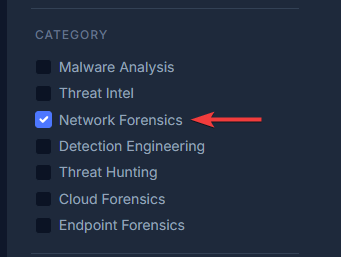
Filter for Community content and Network Forensics (Category). Fifteen free labs are available; 19 premium labs require a subscription.
Step 2 – SANS FOR572: Advanced Network Forensics: Threat Hunting, Analysis, and Incident Response
FOR572: Advanced Network Forensics: Threat Hunting, Analysis, and Incident Response from SANS covers network analysis, protocols, log aggregation, commercial tools, wireless, full-packet analysis, encryption, and capstone exercises. Students may pursue the GIAC Network Forensic Analyst (GNFA) certification. Employer sponsorship is recommended.
BEC and Cloud Forensics
This specialization focuses on cloud platforms, email systems, and Business Email Compromise (BEC) incidents. Hands-on practice and formal training build expertise in cloud and email investigations.
Step 1 – CyberDefenders Labs
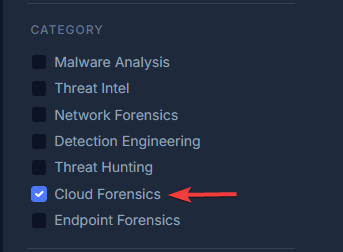
Filter for Community content and Cloud Forensics (Category). No free labs are currently available; seven premium labs require a subscription.
Step 2 – Invictus Incident Response Cloud Courses
For a more structured introduction to cloud forensics, consider completing the Invictus Incident Response courses:
- Incident Response in the Microsoft Cloud: This course covers advanced incident response techniques within Microsoft 365 and Azure environments, providing hands-on exercises to analyze and respond to business email compromises and cloud-based incidents.
- Incident Response in the AWS Cloud: This course focuses on conducting incident response in Amazon Web Services environments, including log analysis, forensic acquisition, and threat hunting across cloud workloads.
These courses provide a practical, in-depth foundation in cloud incident response and help build the skills needed before progressing to more advanced SANS training and certifications.
Step 3 – SANS FOR509: Enterprise Cloud Forensics and Incident Response
FOR509: Enterprise Cloud Forensics and Incident Response from SANS covers incident response across Microsoft 365, AWS, and other platforms, including forensic data collection, log analysis, and advanced techniques. Students may pursue the GIAC Cloud Forensics Responder (GCFR) certification. Employer sponsorship is recommended; completing Invictus courses first is a strong prerequisite.
Malware Analysis
Malware analysis involves reverse-engineering and behavioral study of malicious software. Video lessons, hands-on labs, and SANS training build proficiency.
Step 1 – Watch 13Cubed Playlist: Introduction to Malware Analysis
13Cubed’s Introduction to Malware Analysis playlist provides foundational knowledge in malware concepts, terminology, and techniques.
Step 2 – CyberDefenders Labs
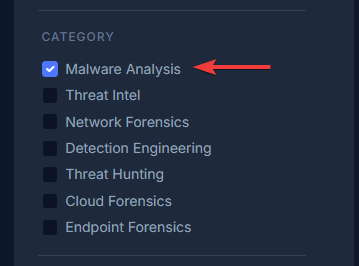
Filter for Community and Malware Analysis (Category). Twenty free labs are available; sixteen premium labs require a subscription.
Step 3 – Complete SANS FOR610: Reverse-Engineering Malware: Malware Analysis Tools and Techniques and Obtain the GREM Certification
FOR610: Reverse-Engineering Malware: Malware Analysis Tools and Techniques from SANS covers static/dynamic analysis, reverse-engineering, debugging, unpacking, and tools. Students may pursue the GIAC Reverse-Engineering Malware (GREM) certification.
Threat Intelligence
Threat intelligence focuses on collecting, analyzing, and contextualizing data to understand adversaries and predict attacks. Hands-on labs and SANS training develop practical expertise.
Step 1 – CyberDefenders Labs
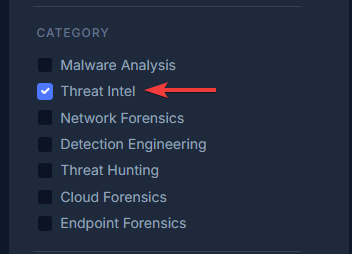
Filter for Community and Threat Intel (Category). Eleven free labs are available; five premium labs require a subscription.
Step 2 – SANS FOR578: Cyber Threat Intelligence
FOR578: Cyber Threat Intelligence from SANS covers the full threat intelligence lifecycle and operationalization. Students may pursue the GIAC Cyber Threat Intelligence (GCTI) certification.
Detection Engineering
Detection engineering involves building, implementing, and refining detection capabilities to identify threats and anomalous behavior. Hands-on labs and SANS training build advanced skills.
Step 1 – CyberDefenders Labs
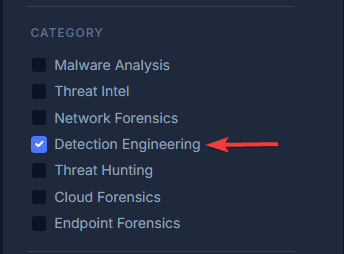
Filter for Community and Detection Engineering (Category). No free labs are available; four premium labs require a subscription.
Step 2 – SANS SEC599: Defeating Advanced Adversaries – Purple Team Tactics & Kill Chain Defenses
SEC599: Defeating Advanced Adversaries – Purple Team Tactics & Kill Chain Defenses from SANS covers advanced detection engineering, threat hunting, and defensive strategies. Students may pursue the GIAC Defending Advanced Threats (GDAT) certification.
DFIR Specializations Roadmap
To recap, DFIR offers a variety of specializations that cater to different skills and interests. From malware analysis and network forensics to cloud investigations and detection engineering, each path builds on the core DFIR foundation in unique ways. This roadmap provides a high-level view of these specializations that I have shared with you, helping you see how they connect and guiding you toward the areas where you can focus your growth and expertise.
| Specialization | CyberDefenders Labs (Community / Premium) | 13Cubed / Invictus | SANS Course | Certification |
|---|---|---|---|---|
| Linux Forensics | 8 / 10 | 13Cubed: Investigating Linux Devices | FOR577: Linux Incident Response & Threat Hunting | GIAC Linux Incident Responder (GLIR) |
| macOS Forensics | 1 / 1 | 13Cubed: Investigating macOS Endpoints | FOR518: Mac & iOS Forensic Analysis | GIAC iOS & macOS Examiner (GIME) |
| Mobile Forensics | 5 / 3 | – | FOR585: Smartphone Forensic Analysis In-Depth | GIAC Advanced Smartphone Forensics (GASF) |
| Network Forensics | 15 / 19 | – | FOR572: Advanced Network Forensics | GIAC Network Forensic Analyst (GNFA) |
| BEC / Cloud Forensics | 0 / 7 | Invictus IR: Incident Response in the Microsoft Cloud Invictus IR: Incident Response in the AWS Cloud | FOR509: Enterprise Cloud Forensics & IR | GIAC Cloud Forensics Responder (GCFR) |
| Malware Analysis | 20 / 16 | 13Cubed: Introduction to Malware Analysis (YouTube Playlist) | FOR610: Reverse-Engineering Malware | GIAC Reverse-Engineering Malware (GREM) |
| Threat Intelligence | 11 / 5 | – | FOR578: Cyber Threat Intelligence | GIAC Cyber Threat Intelligence (GCTI) |
| Detection Engineering | 0 / 4 | – | SEC599: Defeating Advanced Adversaries – Kill Chain Defenses | GIAC Defending Advanced Threats (GDAT) |
Conclusion
Breaking into DFIR is a journey that combines foundational knowledge, hands-on practice, and specialized expertise. Throughout this blog series, we’ve explored a natural progression of steps—from building core skills in windows forensics, memory forensics, and threat hunting, to exploring advanced specializations such as Linux, macOS, mobile, cloud, network, malware analysis, threat intelligence, and detection engineering. Each step is designed to guide you methodically, providing both practical labs and formalized training needed to become a well-rounded DFIR practitioner.
While the specific tools, techniques, and environments may differ across specializations, the underlying mindset remains consistent: uncover malicious activity, connect the dots across datasets, and reconstruct the story of an incident. The difference at scale is that you move beyond single-host analysis and instead piece together the full narrative of an attack, from initial access and lateral movement to exfiltration and impact.
Remember, learning DFIR is not a race. Everyone progresses at their own pace, and it’s perfectly normal to spend more time in areas where you need deeper understanding. What matters most is consistent practice, deliberate skill-building, and leveraging the resources highlighted throughout this series. By following this roadmap, you’ll be equipped with the knowledge, hands-on experience, and certifications to confidently advance your career in DFIR.
DFIR is both challenging and rewarding. Approach it step by step, stay curious, and continue building expertise, and you’ll be well-prepared to tackle real-world incidents and become a valued practitioner in the field.